
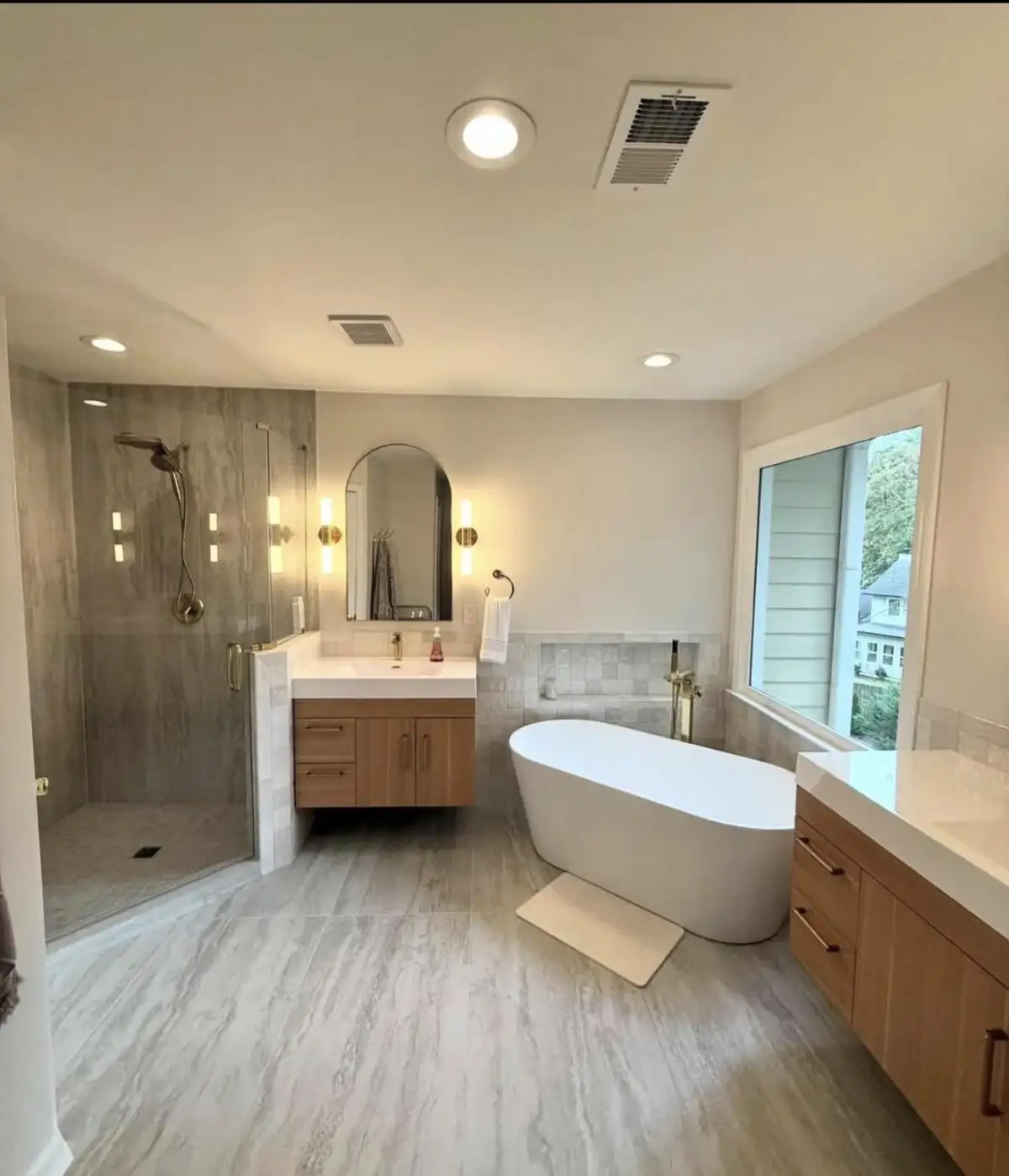
Proper bathroom ventilation is the single most overlooked factor in how long a bathroom remodel lasts. You can install the best tile, the most thorough waterproofing, and the highest-quality fixtures -- but if the room cannot clear moisture effectively, every one of those materials will degrade faster than it should. In the DFW metroplex, where summer humidity routinely pushes past 75 percent and stays there for months, ventilation is not optional. It is a structural necessity.
This guide explains how bathroom ventilation works, what DFW homeowners need to know about sizing exhaust fans for the Texas climate, and why the ventilation plan should be part of every bathroom remodeling project -- not an afterthought addressed during the final walkthrough.
Why Ventilation Matters More in DFW Than Most Markets
The Dallas-Fort Worth metroplex sits in a subtropical climate zone where outdoor relative humidity averages 65 to 80 percent from late May through September. That baseline humidity level means the air entering your bathroom through windows, gaps, and HVAC returns already carries a significant moisture load before anyone turns on a shower.
When you take a hot shower in a poorly ventilated bathroom during a DFW summer, the relative humidity in the room can spike above 90 percent and stay elevated for hours. That sustained moisture creates conditions where mold spores -- which are already present in every home -- begin to colonize grout lines, caulk joints, drywall surfaces, and even the backside of tile installations.
This is different from the risk profile in drier climates like Arizona or Colorado, where a 10-minute shower produces a spike that dissipates quickly. In Texas, the ambient humidity prevents the room from drying on its own. Without mechanical ventilation, the moisture has nowhere to go.
How Exhaust Fans Work (and Why Most Are Undersized)
A bathroom exhaust fan pulls humid air from the room and channels it through ductwork to the outside of the house. The fan's capacity is measured in cubic feet per minute (CFM), which tells you how much air volume the fan can move in 60 seconds.
The industry standard minimum is 1 CFM per square foot of bathroom floor space. A standard 50-square-foot bathroom technically only requires a 50 CFM fan. However, this baseline was established decades ago for moderate climates, and it does not account for several factors that are common in DFW bathrooms.
Factors That Require Higher CFM Ratings
Enclosed shower stalls. A shower enclosure with a glass door or solid walls traps steam more effectively than an open shower layout. Increase to 1.5 CFM per square foot of bathroom space when the shower is fully enclosed.
Jetted or soaking tubs. Large volumes of hot water produce more steam over a longer period. Bathrooms with jetted tubs should use a minimum of 80 to 100 CFM regardless of room size.
Bathrooms without windows. Interior bathrooms rely entirely on mechanical ventilation. There is no passive airflow to supplement the exhaust fan. Oversize by at least 20 percent.
Long duct runs. Every foot of ductwork between the fan and the exterior vent reduces effective CFM. A fan rated at 80 CFM at the unit may only deliver 50 to 60 CFM at the vent if the ductwork includes multiple turns or runs longer than 15 feet. Ask your contractor to calculate equivalent duct length, not just the fan's nameplate rating.
DFW's high ambient humidity. As discussed above, your baseline humidity is already elevated. We recommend a minimum of 1.25 CFM per square foot for any DFW bathroom, and 1.5 CFM for bathrooms with enclosed showers or limited natural airflow.
Signs Your Bathroom Has a Ventilation Problem
Most ventilation problems develop gradually. Homeowners adapt to them without realizing the damage that is accumulating behind the scenes. These are the warning signs we see most often during bathroom remodel consultations across Fort Worth, Arlington, and the surrounding areas.
Foggy mirrors that take more than 15 minutes to clear. If your mirror is still fogged 15 to 20 minutes after your shower ends, the exhaust fan is not removing moisture fast enough. In a properly ventilated bathroom, mirrors should clear within five to ten minutes.
Persistent musty smell. A chronic musty odor in the bathroom -- especially one that worsens in summer -- indicates mold or mildew growth somewhere in the room. This is often behind the tile, under the vanity, or inside the wall cavity where you cannot see it.
Peeling paint or bubbling on the ceiling. Moisture migrating through drywall causes paint to lose adhesion. If your bathroom ceiling peels or bubbles repeatedly, the problem is not the paint. The problem is uncontrolled humidity.
Discolored or crumbling grout. Grout that darkens, cracks, or deteriorates within two to three years of installation is almost always a humidity issue rather than a material defect. Properly maintained grout in a well-ventilated bathroom should last 10 to 15 years before needing resealing.
Mold along caulk lines. Black mold along the caulk where the tile meets the tub or shower base is the most visible sign of excessive moisture. While you can remove surface mold with cleaning products, it will return until the root cause -- inadequate ventilation -- is addressed.
What We Recommend: Ventilation as Part of Every Remodel
At Water & Stone, we evaluate the ventilation system in every bathroom we remodel. This is not an upsell. It is a fundamental part of protecting the investment our clients make in their remodeling projects. A $20,000 bathroom remodel with a $30 exhaust fan that vents into the attic instead of outside is a $20,000 remodel with a built-in failure point.
Here is what a proper ventilation setup looks like in a DFW bathroom remodel.
Properly Sized Exhaust Fan
We calculate CFM based on actual room dimensions, shower enclosure type, duct run length, and the number of moisture-producing fixtures in the room. The fan is selected to deliver adequate CFM at the vent -- not just at the unit. Quality bathroom fans from manufacturers like Panasonic and Broan operate at 0.3 to 1.0 sones, which means they are quiet enough to leave running without being intrusive.
Dedicated Exterior Venting
The exhaust fan must vent to the outside of the house through a dedicated duct with a dampered exterior cap. Venting into the attic -- which is shockingly common in older DFW homes -- dumps all that shower moisture into the attic space, where it can cause roof sheathing rot, insulation damage, and attic mold growth that spreads far beyond the bathroom. During every remodel, we verify the duct path and correct any attic-vented configurations.
Humidity-Sensing Controls
The most effective exhaust fans include built-in humidity sensors that automatically activate the fan when moisture levels rise and keep it running until the room returns to a safe humidity level, typically around 50 percent relative humidity. This eliminates the guesswork of "how long should I leave the fan on" and ensures consistent moisture control regardless of the homeowner's habits.
Waterproofing as the Second Line of Defense
Ventilation is the first line of defense against moisture damage. Waterproofing is the second. Even with a perfectly sized exhaust fan, some moisture will always reach tile and grout surfaces. Behind those surfaces, a continuous waterproofing membrane -- like the Schluter-KERDI system we use on every walk-in shower installation -- prevents any moisture that penetrates the tile from reaching the wall structure. Together, ventilation and waterproofing create a two-layer protection system that dramatically extends the life of a bathroom remodel. For more on waterproofing and its role in remodel durability, see our bathroom remodel cost guide.
Common Ventilation Mistakes We See in DFW Homes
Undersized fans from the original builder. Many production homes in the DFW area are built with the smallest code-minimum exhaust fan available. These 50 CFM fans are adequate for code compliance but not for real-world performance, especially in Texas humidity.
Disconnected or kinked ductwork. Flexible duct that has separated from the fan housing or kinked in the attic reduces airflow by 30 to 50 percent. The fan sounds like it is working, but little air is actually reaching the exterior vent.
Recirculating fans with no exterior vent. Some older bathrooms have "exhaust fans" that filter air and recirculate it back into the room without actually removing moisture. These are essentially useless for humidity control.
Vent terminating under a soffit. When the duct vents under the roof soffit rather than through the roof or an exterior wall, the humid exhaust air gets pulled right back into the attic through the soffit vents. This creates the same problem as venting directly into the attic.
Frequently Asked Questions
What size exhaust fan do I need for my bathroom?
The minimum standard is 1 CFM per square foot of bathroom floor space. A 50-square-foot bathroom needs at least a 50 CFM fan. For bathrooms with a separate shower enclosure, jetted tub, or steam shower, increase to 1.5 CFM per square foot. In the DFW climate, where outdoor humidity regularly exceeds 70%, oversizing by 20% provides a meaningful performance buffer.
How long should I run the bathroom exhaust fan after a shower?
Run the exhaust fan for at least 20 to 30 minutes after finishing your shower. This allows the fan to remove residual moisture from surfaces, grout lines, and the air itself. A humidity-sensing fan automates this process by running until the moisture level drops below a set threshold, typically around 50% relative humidity.
Can poor ventilation void my bathroom remodel warranty?
Yes. Many tile adhesive and waterproofing manufacturers require adequate ventilation as a condition of their product warranties. Prolonged exposure to excessive humidity can degrade thin-set bonds, promote mold growth behind tile, and cause grout to deteriorate prematurely. Even a properly waterproofed shower can develop problems if the room itself traps moisture day after day.
Does DFW humidity affect bathroom remodeling differently than other regions?
Yes. The DFW metroplex averages 65% to 80% outdoor relative humidity from May through September, which means your bathroom starts at a higher baseline moisture level before you even turn on the shower. Bathrooms in DFW need more aggressive ventilation, proper waterproofing membranes, and moisture-resistant materials to compensate for the climate.
The Bottom Line
Ventilation is not a finishing detail. It is a structural component of every bathroom remodel that directly determines how long your tile, grout, fixtures, and waterproofing will last. In the DFW climate, where humidity is an unavoidable factor for five months of the year, a properly sized and correctly vented exhaust fan is as important as the waterproofing membrane behind your tile.
When we plan a bathroom remodel, ventilation is part of the design conversation from day one -- not a checkbox we address at the end. If your current bathroom has signs of moisture damage, persistent mold, or an exhaust fan that struggles to clear the mirror, that is worth addressing before the problem spreads into the wall structure.
Water & Stone provides complete bathroom remodeling across the DFW metroplex, including Fort Worth, Arlington, Southlake, Flower Mound, and surrounding communities. Request a free quote or call (817) 631-3269 to discuss your project.