The tile you see on the walls of your shower is not what keeps water out of your home's structure. Tile is decorative and durable, but it is not waterproof. The grout between tiles absorbs water. The substrate behind the tile absorbs water. Without a proper waterproofing system between the tile surface and the wall framing, every shower in your home is allowing moisture to migrate into the wall cavity — slowly, invisibly, and destructively.
This is the single most important detail in any shower remodel, and it is the detail most often done poorly or skipped entirely by contractors looking to save time and materials. In the DFW metroplex, where 500+ completed projects have shown us exactly what happens when waterproofing fails, we have seen the consequences firsthand: rotted framing, black mold behind walls, buckled tile, and bathroom remodels that need to be torn out and redone within 3-5 years of installation.
Why Waterproofing Matters More in Texas
Every bathroom needs waterproofing regardless of geography. But the DFW climate makes waterproofing failures more destructive and more rapid than in cooler, drier regions.
Extreme Heat Accelerates Mold Growth
Mold thrives in warm, moist environments. A wall cavity in a Fort Worth home that retains moisture from a poorly waterproofed shower provides ideal growing conditions 8-10 months per year. Interior wall cavities in DFW homes regularly exceed 80 degrees during summer months even with air conditioning, because the exterior walls absorb solar heat that radiates inward. Combined with moisture from shower use, this creates a mold incubator inside your walls that you cannot see or smell until the damage is extensive.
Soil Movement Creates Cracks
DFW's expansive clay soils cause soil movement that most homes experience to some degree. This movement creates hairline cracks in grout joints and substrate seams. In a properly waterproofed shower, these cracks are cosmetic — the membrane behind the tile continues to keep water out of the wall. In an unprotected shower, every crack becomes a water entry point. Soil movement and inadequate waterproofing are the two most common combined factors in the shower failures we diagnose during bathroom remodel consultations.
Hard Water Degrades Grout Faster
DFW tap water is notoriously hard, with mineral content well above the national average. These minerals deposit on tile and grout surfaces, but they also accelerate grout deterioration from the inside. Hard water breaks down standard sanded grout faster than soft water, creating porous pathways for moisture to penetrate behind the tile layer. Proper waterproofing ensures that even as grout degrades over time (which it inevitably will), the wall structure remains protected.
How Shower Waterproofing Systems Work
A shower waterproofing system creates a continuous barrier between the tile surface and the wall framing (or floor structure). This barrier allows water to hit the tile, flow down to the drain, and exit the shower without ever reaching the substrate, studs, or subfloor. There are three primary waterproofing methods used in residential shower construction.
Sheet Membrane Systems
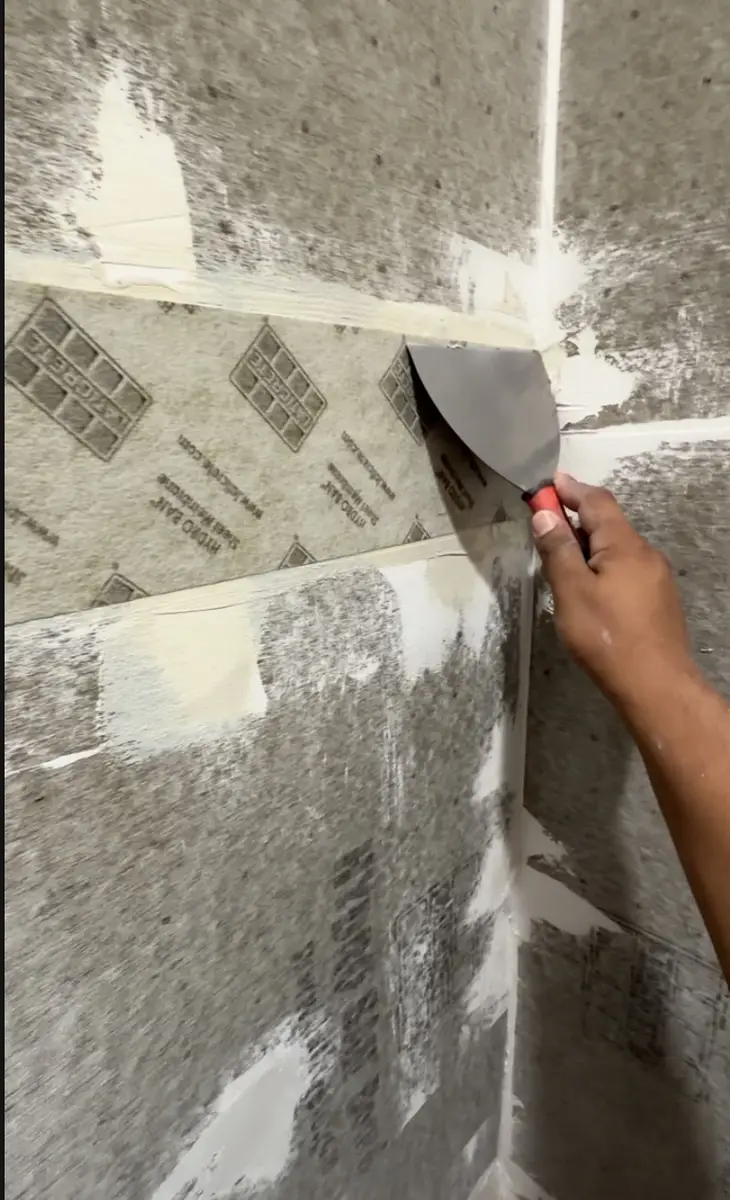
Sheet membranes (Schluter Kerdi is the most recognized brand) are thin, flexible waterproof sheets that bond directly to the substrate with thin-set mortar. Tile is then installed on top of the membrane using compatible thin-set. The membrane creates a physical barrier that is fully waterproof at the sheet level — water cannot pass through it regardless of how much moisture the grout or tile absorbs.
Sheet membranes are our preferred system for most DFW shower remodels because they provide predictable, consistent coverage with minimal reliance on installer skill to achieve waterproof performance. The membrane is either waterproof or it is not — there is no guessing about coating thickness or cure time. Seams and corners are sealed with preformed accessories (corner pieces, pipe collar seals) that eliminate the most common failure points.
Liquid-Applied Membranes
Liquid membranes (RedGard, Hydroban, Laticrete Hydro Ban) are applied by roller or trowel directly to the substrate. They cure to form a flexible, waterproof coating. The advantage of liquid membranes is that they conform to irregular surfaces and can be applied in areas where sheet membranes are difficult to install. The disadvantage is that waterproof performance depends entirely on achieving the correct coating thickness — too thin and the membrane has pinholes; too thick and it may not bond properly with the tile adhesive.
In our experience, liquid membranes perform well when applied by skilled installers who verify coverage thickness, but they are more prone to application error than sheet systems. We use liquid membranes primarily for supplementary waterproofing in hard-to-reach areas, niches, and bench seats, rather than as the primary barrier on large wall surfaces.
Foam Backer Board Systems
Pre-waterproofed foam backer boards (Schluter Kerdi-Board, Wedi Board) combine the substrate and waterproofing membrane into a single product. The board itself is waterproof, so installing it eliminates the need for a separate membrane application step. Tile bonds directly to the board face.
These systems are particularly effective for complete shower rebuilds where you are replacing the substrate entirely, as you get structure and waterproofing in one installation step. They are also lighter than traditional cement board, which reduces the load on wall framing — a relevant consideration in DFW homes where framing tolerances can be affected by soil movement.
The Five Critical Waterproofing Zones in Every Shower
A shower is only as waterproof as its weakest point. These are the five zones where failures occur most frequently, and where waterproofing must be absolutely continuous.
1. Shower Floor and Shower Pan
The shower floor takes more water contact than any other surface. The shower pan — the waterproof layer beneath the floor tile — must slope correctly toward the drain (minimum 1/4 inch per foot) and create a watertight seal around the drain assembly. A shower pan failure is the most expensive waterproofing problem to fix because it requires removing all floor tile, the mortar bed, and the membrane to access the pan beneath.
2. Wall-to-Floor Transition
The junction where vertical walls meet the horizontal floor is a primary failure point. Movement, settling, and thermal expansion create stress at this intersection that can crack rigid waterproofing connections. The solution is a flexible transition treatment — either a preformed band (for sheet systems) or a reinforcing mesh embedded in liquid membrane — that accommodates movement without compromising the seal.
3. Corner Joints
Every inside corner of the shower (wall-to-wall and wall-to-ceiling) is a potential failure point because the two surfaces move independently. Like the wall-to-floor transition, corners require flexible treatment. Preformed corner pieces for sheet systems, or mesh-reinforced liquid membrane applications, ensure that the waterproof barrier flexes with the structure rather than cracking under stress.
4. Plumbing Penetrations
Every hole through the waterproof barrier — the shower valve, the shower head pipe, body sprays, handheld holders — is a potential water entry point. Each penetration needs a dedicated seal. For sheet systems, pipe collar accessories create a watertight seal around the penetration. For liquid systems, a thick application around each penetration with mesh reinforcement provides the barrier. The most common mistake we see in failed showers is inadequate or missing seals around plumbing penetrations.
5. Niches and Benches
Built-in niches (recessed shelving for shampoo and soap) and shower benches add complexity to the waterproofing challenge. Every niche has five interior surfaces that need waterproofing, plus the transition from the niche back to the wall plane — that is 10+ additional seams per niche. We use pre-fabricated waterproof niche inserts whenever possible, which reduce the seam count from 10+ to 4 (one at each edge of the insert). For custom niches, every interior surface receives full membrane coverage with reinforced corner and transition treatments.
Signs Your Current Shower Has a Waterproofing Problem
Waterproofing failures are not always obvious. The water is behind the wall, and the damage accumulates over months or years before visible symptoms appear. Here are the warning signs.
- Loose or hollow-sounding tiles: Tap the tile surface with a knuckle. A hollow sound (versus a solid thud) indicates that the thin-set bond has failed, often because moisture has compromised the substrate behind it.
- Crumbling or missing grout: Grout that repeatedly falls out or crumbles despite re-grouting suggests chronic moisture exposure that is breaking down the grout from behind.
- Musty smell in or near the bathroom: A persistent musty odor that cleaning does not eliminate may indicate mold growth inside the wall cavity.
- Soft or spongy drywall adjacent to the shower: Press the wall surface immediately outside the shower enclosure. If the drywall feels soft or gives under pressure, moisture has migrated through the wall from the shower side.
- Staining on the ceiling below a second-floor bathroom: Water stains, bubbling paint, or sagging drywall on the first-floor ceiling directly below an upstairs shower is the clearest sign of a shower pan or floor waterproofing failure.
- Visible mold at grout lines: Surface mold on grout is common and treatable. But mold that reappears within days of cleaning, or appears in the same spots repeatedly, suggests a moisture source behind the tile feeding the growth.
If you see any of these signs, the problem will not improve on its own. Water damage is progressive — the longer it continues, the more extensive (and expensive) the repair.
What Proper Waterproofing Costs in a DFW Bathroom Remodel
For a standard shower enclosure (approximately 3 feet by 5 feet with three tiled walls), professional waterproofing adds $800 to $1,500 to the project cost. This covers materials (membrane, sealants, corner and pipe accessories) and the labor time required for proper installation and inspection before tile work begins.
For a larger master shower with a bench, niche, and multiple plumbing penetrations, waterproofing costs may reach $1,500 to $2,500 due to the additional complexity and material.
These costs represent roughly 5-10% of a typical bathroom remodel budget in Fort Worth. Compare that to the cost of a waterproofing failure: $5,000 to $15,000 for a tear-out and redo of a failed shower, not including mold remediation if the damage has spread into the wall cavity (which can add $3,000 to $10,000 depending on extent).
Waterproofing is the highest-ROI investment in any shower remodel. No other line item delivers a 10:1 return on failure prevention.
Questions to Ask Your Contractor
Before hiring any contractor for a bathroom remodel or shower remodel in DFW, ask these waterproofing-specific questions:
- What waterproofing system do you use? They should name a specific product (Kerdi, RedGard, Hydroban, Wedi) — not just "we waterproof." If the answer is "we use cement board, that's waterproof," walk away. Cement board is moisture-resistant, not waterproof.
- Do you waterproof the entire shower, including the ceiling? Many contractors waterproof the lower half of walls and skip the upper walls and ceiling. In a steam-prone DFW bathroom, the upper walls and ceiling get wet every shower.
- How do you handle the shower floor and drain connection? The drain-to-membrane seal is the most technically demanding waterproofing detail. The contractor should describe a specific method for creating a watertight connection.
- Do you flood-test the shower pan before tiling? A flood test (filling the shower pan with water and monitoring for 24 hours) is the only way to verify waterproof integrity before tile goes down. If they do not flood-test, they are guessing.
Protect Your Investment
A shower remodel is a significant investment. The tile, the fixtures, the glass enclosure — everything you see and touch — depends entirely on the waterproofing you cannot see. Getting this right from the start means your new shower will perform for 20-30 years without structural damage, mold problems, or the expense of a premature tear-out.
At Water and Stone, waterproofing is not an optional add-on. It is built into every shower project we complete, because we have seen what happens when it is done poorly. If you are planning a walk-in shower installation, a tub-to-shower conversion, or a complete bathroom remodel in Fort Worth, Arlington, Southlake, or anywhere in the DFW metroplex, contact us to discuss your project or call (817) 631-3269.